

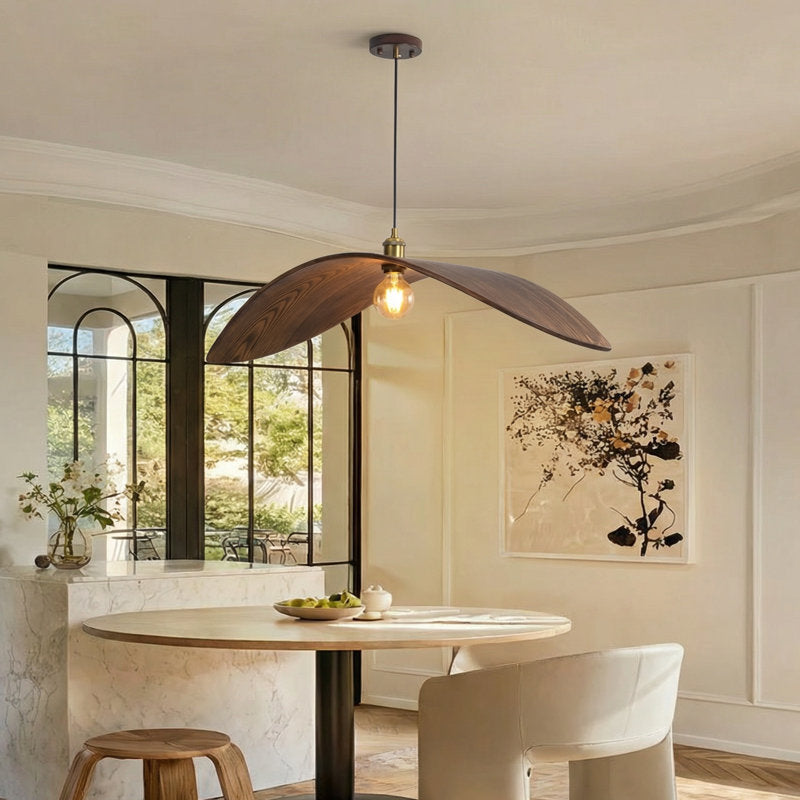
A japandi pendant light is the fastest way to make a dining table or kitchen island feel finished: one soft shape in paper, wood or frosted glass, hung low enough to pool warm light on the table and leave the rest of the room quiet. Below are the five pendant types that work in a Japandi home, the hanging rules we use (height, diameter, how many over an island), the bulbs that matter, and our 10 picks from the stores we partner with.
Why one pendant changes a Japandi room
Most dining rooms are lit by a flat ceiling fixture or recessed cans: even, white and a little clinical. A pendant brings the light down to about eye level when you are seated, so the glow lands on the table and the faces around it while the corners of the room fall into soft shadow. That contrast is what people mean by "cozy".
In a Japandi home the pendant is often the only sculptural object in the room. The furniture is low, the palette is oak, white and stone, and there is little on the walls, so a paper lantern or a bent piece of wood above the table gives the eye one place to rest. The honest trade-off: a pendant is hardwired, hangs at a fixed height, and the wrong size looks worse than no pendant at all. The rest of this guide is about getting that right.
The five types of Japandi pendant light
Paper lantern and rice-paper shade
A white paper or fabric shade over a thin metal frame that glows evenly when lit and reads as a soft cloud when off. It gives the most diffused, flattering light of any pendant. The downside: paper cannot be wiped, so over a cooktop we steer people to a washable material (see the FAQ).
Wood
A bent or carved wood shade in a natural oak tone, sometimes with the bulb exposed underneath. Warmer than paper, and it ties into an oak table without effort. Wood throws light downward rather than all around, so treat it as table light, not room light.
Linear, for long tables and islands
A single bar of wood or metal, 30 to 48 inches wide, with an LED strip underneath. One linear pendant lights a six- or eight-seat table evenly, with no dark ends and no cords to align. Clean and a little architectural.
Cloud and sculptural
Hand-shaped shades in plaster-like resin or polystyrene, irregular forms, asymmetric canopies: the wabi-sabi side of Japandi, where a slightly imperfect shape is the point. They look best alone, over a table with simple chairs.
Flush mount, for low ceilings
Under an 8-foot ceiling, a pendant hung 30 inches over the table ends up too close to heads. A rounded flush mount, such as a cloud-shaped LED disc, gives the same warm glow without the drop. One is in the picks below.
Sizing and hanging height over a dining table and a kitchen island
These rules of thumb fix the two most common mistakes: hanging too high and buying too small.
- Height over a dining table: the bottom of the shade should sit 28 to 34 inches above the tabletop. Lower blocks the view; higher spreads the light and loses the intimate effect. Above a 9-foot ceiling, add about 3 inches per extra foot.
- Diameter over a dining table: about one half to two thirds of the table's width. For a 36-inch-wide table, that is a pendant 18 to 24 inches across. A long rectangular table is better served by a linear pendant or two pendants spaced evenly.
- Height over a kitchen island: the same 28 to 34 inches above the counter, as long as the lowest point clears the head of the tallest person standing there; 30 to 32 inches is the sweet spot.
- How many over an island: two pendants for an island up to about 6 feet long, three for 7 to 9 feet. Set the outer pendants 12 to 18 inches in from each end, keep 24 to 30 inches between centers, and choose smaller shades (10 to 14 inches) when you hang more than one.
- Center it on the table, not the room: if the table does not sit under the ceiling box, use a swag hook or have the box moved. An off-center pendant is the one mistake you cannot hide.
Before you order, tape a circle of the pendant's diameter on the tabletop and hold a tape measure up at 30 inches. It saves a return.
Bulbs and warm light
- Color temperature: 2700K is the warm white that paper, wood and linen look best under; 3000K is fine over an island where you also prep food. Avoid "daylight" bulbs of 4000K and up, which turn a white shade blue-gray.
- Dimmable: a dining pendant should go from homework-bright to dinner-low, so buy a dimmable bulb and a dimmer switch. Integrated-LED pendants usually say whether they dim.
- Bulb shape when it shows: if the bulb is exposed, as on many wood pendants, pick a large globe bulb with a warm filament look. It becomes part of the design.
Most pendants below take a standard E26 bulb; a few have an integrated LED.
The 10 best Japandi pendant lights for the dining table and kitchen
Japandi Paper Pendant Light

Our most-ordered pendant for the paper-lantern look over a dining table. A cloud-like white membrane shade on a wrought iron frame with an integrated LED, so the light is diffused with no hot spot and no visible bulb; the height adjusts at installation. Around $250. Best over a table of four to six, away from the splash zone of a cooktop.
Japandi Living Room Pendant Light - Shibui

Despite the name, this is our favorite value pendant for a dining table. Each shade is shaped by hand from polystyrene (over 8 hours per piece, says the maker), so no two are identical, and lit it glows like a small cloud. Five widths from 12 to 32 inches: the 50 cm (about 20 inch) size suits a dining table, 60 to 80 cm an island. Takes any standard dimmable bulb, with a 1.5 m cord you can shorten. Around $115, remarkable for a handmade shade. Dust with a dry cloth only.
Japandi Paper Cone Pendant Light - Akairo

A taller, cone-shaped paper shade on a sturdy frame, for people who like the glow of a paper lantern but want a sharper silhouette. The cone pushes more light downward than a round lantern, and it looks good in a pair over a long table. Around $465. Beautiful in a dining room, less practical above a stove.
Japandi Translucent Glass Pendant Light - Hikari

Our answer to "I want a paper lantern in the kitchen." A gently curved dome of frosted, ribbed glass that diffuses light the way a rice-paper shade does, but wipes clean with a damp cloth; the fine vertical lines read as paper from across the room. Around $475. Ideal over an island or breakfast table where steam and splashes are a fact of life.
Japandi Curved Wood Pendant Light - Leaf

A single curved leaf of wood-grain finish on an iron fixture that hangs almost flat, with one E26 bulb exposed underneath, so it reads as a sculpture and still throws plenty of light down. The 33-inch width is right for a six-seat table or an island; the 24 and 14 inch sizes suit a breakfast nook. Cord adjusts up to 78 inches, hardwired, max 60W bulb not included (a large G30 globe looks best). Around $310. A newer listing with only a handful of reviews so far, and because the bulb shows, choose a warm decorative one.
Japandi Elegant Glass Pendant Light - Svelora

The pendant we recommend when you need two or three over an island on a budget. A slim, cone-shaped wooden shade with a softly glowing bulb, hung from a black cord with brass detailing. It gives focused downlight for chopping and reading, and the narrow profile means three in a row do not crowd the counter. Around $180 each.
Japandi Organic Curved Pendant Light - Canyen

Our linear pick for a table of six to eight or a big island. A gently bent length of warm-toned wood with an integrated LED, suspended on thin cables so it appears to float, lighting the full length of the table evenly with no cords to align. Around $420. The LED is built in, so check the stated color temperature and dimming before you order.
Irregular Japandi Pendant Light - Eileen

The sculptural choice. An organic, flowing shape in a black exterior with a warm terracotta interior, so the light reaching the table comes out warm before you choose the bulb. Hang it alone over a round table with plain oak chairs. Around $410. If your room already has a lot of texture (rattan, a busy rug, open shelving), a quieter white shade may serve you better.
Japandi LED Pendant Light - Odeon

A clean drum-shaped shade with an integrated LED, in black or grey. The drum is the safest shape for a dining table because it throws light down and out at once, so the table is bright and the people around it are lit kindly. Adjustable suspension height. Around $495.
Japandi LED Ceiling Light - Nephele

For low ceilings. A round, layered cloud of frosted acrylic on an iron frame that sits about 3.5 inches off the ceiling, with no visible LEDs and no glare. Two sizes, 40 cm (15.7 inches) and 50 cm (19.7 inches); the integrated LED is warm white 3000K, rated for 50,000 hours, and dims from the included remote. Around $335. Choose the 50 cm size over a dining table or island.
More pendants for a kitchen island
 Japandi Ribbed Textured Pendant Light – Menra
 Japandi Stone & Brass Pendant Light – Palermo
 Japandi Textured Glass Pendant Light – Valma
 Japandi Round Minimalist Pendant Light – Tuvra
FAQ
How high should a pendant hang over a dining table?
Hang the bottom of the shade 28 to 34 inches above the tabletop, with 30 inches as the safe default under an 8-foot ceiling. Sit down before the electrician leaves: you should see the person opposite you under the shade, not through it.
Can I use a paper pendant in a kitchen?
Yes over a breakfast table or an island used mostly for sitting; no directly above a cooktop or sink, because paper and thin fabric hold grease and steam and cannot be washed. If you love the look in a working kitchen, choose a frosted ribbed glass pendant like the Hikari, which gives the same soft glow and wipes clean.
How many pendants should I hang over a kitchen island?
Two for an island up to about 6 feet long, three for 7 to 9 feet, or one linear pendant of 30 to 48 inches for either. Keep 24 to 30 inches between centers, set the outer pendants 12 to 18 inches in from the ends, and use smaller shades when you hang more than one.
Complete your Japandi dining room and kitchen
- Japandi dining tables, the oak and walnut tables these pendants are sized for.
- Japandi floor lamps, for the second layer of light in the corner of the room.
- Japandi ceiling lights, flush mounts for hallways, bedrooms and low ceilings.
- All Japandi pendant lights, the full collection of paper, wood, glass and linear pendants.
Pick the type that fits your ceiling, measure twice, use a warm dimmable bulb, and the right japandi pendant light will do more for your dining table than any other single purchase.
Japandistore selects products from partner stores and may earn a commission when you buy through our links. Prices are set by the stores and can change.

Leave a comment
This site is protected by hCaptcha and the hCaptcha Privacy Policy and Terms of Service apply.