

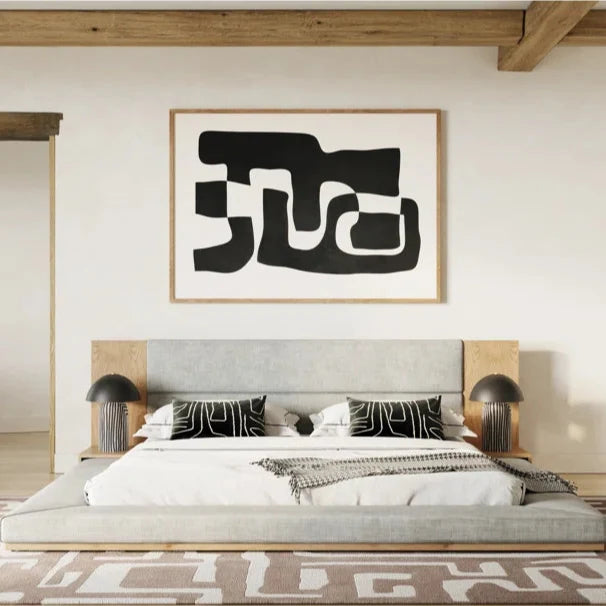
A Japandi bed is a low platform bed, usually in light or mid-tone wood, with a simple headboard (or none at all) and no box spring. If the frame sits close to the floor, shows honest wood or a calm neutral fabric, and has nothing shiny on it, you are looking at a Japandi platform bed. Below we compare platform, tatami-style and upholstered frames, help you decide how low is comfortable for you, and share our 10 favorite Japandi beds with honest notes on height, materials and trade-offs.
What makes a bed Japandi
Japandi blends Japanese minimalism with Scandinavian warmth. In a bed, that means four things:
- Low to the floor. A Japandi frame is typically 12 to 15 inches high at the platform, so the top of the mattress lands around knee height instead of hip height, and the room feels taller and calmer.
- Visible wood. Oak, ash, walnut or rubberwood, left natural or lightly stained. Even upholstered Japandi beds usually show wooden legs or a wooden base.
- No box spring. A platform bed has a slat base that supports the mattress on its own, which keeps the profile low.
- A calm headboard, or none. A plain wood panel, a slatted screen, a rounded shape in linen or bouclé, or simply the wall. No tufting, no nailheads, no sleigh shapes.
Platform, tatami-style or upholstered headboard?
Wood platform bed
The purest version: a wood frame with slats, with or without a simple headboard. It is the easiest to keep clean and often the most affordable. The trade-off is sitting up in bed: a bare wood headboard is not something you lean on for long, and no headboard means pillows rest against the wall.
Tatami-style or floor bed
These sit even lower, sometimes with side panels that extend past the mattress to form built-in nightstands. They give the most Japanese look and are the safest choice for toddlers. The trade-off is getting up in the morning (more below) and the lack of storage underneath.
Upholstered headboard on a wood base
The Scandinavian half of Japandi: a linen or bouclé headboard, often rounded, on a low platform with wooden legs. It is the most comfortable for reading in bed, but light fabric shows marks and bouclé can catch on pet claws. Look for no-shed bouclé or a linen blend if you have animals.
How low is comfortable: height and getting in and out
A standard bed puts the top of the mattress around 25 inches from the floor, roughly knee height, which is the easiest to get out of. A Japandi platform bed with a 12 to 14 inch frame and a 10 to 12 inch mattress lands around 22 to 26 inches: lower than it looks, but easy for most people. A true tatami or floor bed can put you at 15 to 18 inches, and that is where opinions divide. Buyers of our lowest beds love the look, and some find them harder to get out of than expected. Think twice about a very low bed if:
- you have knee, hip or back problems;
- you are pregnant or regularly get up during the night;
- you need under-bed storage (most of these frames leave 6 to 10 inches, not enough for standard boxes);
- you use a thin mattress: a 12 inch frame with a 6 inch mattress is a floor bed, whether you planned it or not.
Size and bedroom layout
Measure before you buy:
- Queen (about 60 by 80 inches). The standard choice for a 10 by 12 foot bedroom, with room for two nightstands and a walkway on each side.
- King (about 76 by 80 inches). Needs a room of at least 12 by 12 feet to leave 24 to 30 inches of walkway on each side. Several upholstered beds in our collection come in king only.
- Headboard height. A headboard of 37 to 48 inches is tall enough to lean on and still leaves wall space for one piece of art. No headboard works best against a plain wall with a wall-mounted cushion.
- Extended side panels. Tatami-style frames with built-in nightstands are much wider than the mattress; check that the width fits between closet and window.
Wood tones and bedding colors
Japandi bedrooms work with two palettes. Pale wood (natural oak, ash, light rubberwood) with white, oatmeal or sand bedding gives the bright Scandinavian version. Walnut or black walnut with cream, clay or charcoal bedding gives the darker, moodier Japanese version. Both work; the mistake is mixing three wood tones in one room, so match the bed to your nightstands and dresser. For bedding, linen or washed cotton in one or two neutrals, one throw at the foot of the bed, two pillows and two cushions, then stop. For room ideas beyond the bed itself, see our guide to the Japandi bedroom.
The 10 best Japandi beds (and who each one is for)
Japandi Tatami Bed

Our most popular bed, and the one that defines the look. It sits close to the floor like a traditional tatami frame, and the side panels extend past the headboard to work as two built-in nightstands. The channel-stitched padded headboard softens the oak veneer frame. Natural Oak, Walnut or Gray, in Queen, King and California King, with a slat kit included and a 440 lb capacity. Around $2,100. Honest note: it weighs about 248 lb (two people to assemble) and it is genuinely low, so skip it if you have knee or back trouble. See details
Japandi King-size Boucle Bed

The softest option on this list: a gently curved silhouette in white bouclé on a solid wood frame, with rounded wooden legs peeking out below the fabric, which is what keeps it Japandi rather than simply a white bed. The tall headboard is good for reading in bed. King only, with steel slats. Around $1,700. White bouclé shows marks, so it suits a calm adult bedroom better than a house with dogs. See details
Japandi Linen Low Profile Platform Bed

A low, wide platform wrapped in a linen-look fabric (93% polyester, 7% linen, so it resists wrinkles and spills better than pure linen). The padded headboard is generous without being tall, and the wide base gives the bed a grounded, quiet shape. Around $1,600. For anyone who wants a soft bed in a pale neutral that will not fight with wood nightstands. See details
Japandi Bed with Extended Headboard

An oak veneer frame (engineered wood and plywood, solid pine center leg) with a headboard that runs wider than the mattress, so a nightstand tucks in front of it and the whole wall reads as one calm wooden line. Around $2,050. The bed for a larger bedroom where you want it to anchor the wall; in a small room the extended headboard can feel like too much furniture. See details
Japandi Boucle Cloud Floor Bed (King)

The lowest upholstered bed in our collection. The frame sits right down near the floor and the circular headboard softens everything around it, in a plush, no-shed bouclé that answers the usual pet worry. King size, around $1,100, the most affordable upholstered king here. Read the height section first: this is a floor bed, lovely to lounge on, less easy to spring out of. See details
Japandi Wooden Bed

Clean, straightforward and all about the grain: a mindi veneer in a natural finish, straight lines and a plain wooden headboard. Around $1,170. The natural tone sits between pale oak and walnut, so it matches almost anything. Honest note: it is veneer over particle board, not solid wood, which explains the price. See details
Japandi Low Solid Wood Platform Bed - Amaryn

Sometimes the best Japandi bed is the one you barely notice. This solid wood frame is 12 inches high with solid wood slats and no headboard, so the bedding does the talking. Twin to King, in natural, cherry, white and espresso, rated 4.8 stars by close to 14,000 buyers. Around $240. The catch: only 6.3 inches of clearance, so forget storage boxes, and you will want a wall cushion behind the pillows. See details
Japandi Solid Wood Platform Bed with Headboard - Kira

For people who want real wood, a simple headboard and nothing that creaks. The frame is solid wood reinforced with steel, the back of the headboard is finished so the bed can float away from the wall, and most buyers assemble it in under an hour. More than 7,400 buyers rate it 4.7 stars. Around $400, Twin to King. One tip from the reviews: the wood can arrive darker than the photos, so pick the light natural finish for a pale look. See details
Japandi Mid-Century Wood Bed with Slat Headboard - Bilal

The slatted headboard is the whole point: it brings the vertical rhythm of a Japanese screen without any fabric to keep clean, and the low footboard keeps the frame light. The Queen stands 37.6 inches at the headboard with 7.5 inches underneath. Natural or black walnut, Twin to King, 4.5 stars. Around $240. Natural for a pale bedroom, black walnut for the moodier palette. See details
Japanese Joinery Platform Bed - Carruthers

Traditional Japanese joinery: the solid rubberwood pieces slot together without screws or tools, so it goes up in minutes and comes apart just as easily when you move. At 14 inches high with no headboard it is the closest thing to a floor bed that still leaves 10.5 inches underneath, the most of any low frame here. Light oak, light brown, walnut or charcoal; Twin XL to King; 4.8 stars. Around $260. Pillows rest against the wall, so add a wall-mounted cushion. See details
More Japandi beds worth a look
 Japandi Wood Bed with Cream Boucle Headboard - Ardin
 Japandi Bed with Curved Headboard
 Japandi King Linen Bed with Walnut Legs
Frequently asked questions
Do Japandi beds need a box spring?
No. Every bed in this guide is a platform bed with a slat base that supports the mattress on its own. A box spring would raise the mattress by 8 or 9 inches and ruin the low profile. Most mattresses are fine on slats; just check that the slat gaps meet your mattress maker's limit (usually about 3 inches).
How low is too low for a bed?
If the mattress top sits more than a few inches below the back of your knee, getting up takes effort. For most adults a mattress top below about 18 inches is a lifestyle choice rather than a practical one. A 12 to 14 inch frame with a 10 to 12 inch mattress is comfortable for almost everyone; a true floor bed is best for people who are mobile.
What nightstand goes with a low bed?
Keep the nightstand top level with the mattress top or up to 4 inches above it: with a 22 to 26 inch mattress top, that means a nightstand around 20 to 26 inches tall. A wood cube, a small round table or a floating shelf all work; see our Japandi nightstands.
Complete your Japandi bedroom
- Japandi nightstands: low wood and rattan tables that sit level with a platform bed.
- Japandi rugs: wool and jute rugs to put under and around a low bed.
- Japandi table lamps: paper lantern and linen-shade lamps for warm bedside light.
- Japandi dressers: oak and walnut dressers to match your bed's wood tone.
Whichever you choose, the right Japandi bed sits low enough to calm the room but high enough that you get out of it happily every morning, shows some honest wood, and matches the other wood in the room. Get those three things right and a Japandi platform bed is the easiest piece of furniture you will ever decorate around.
Japandistore selects products from partner stores and may earn a commission when you buy through our links. Prices are set by the stores and can change.

Leave a comment
This site is protected by hCaptcha and the hCaptcha Privacy Policy and Terms of Service apply.