

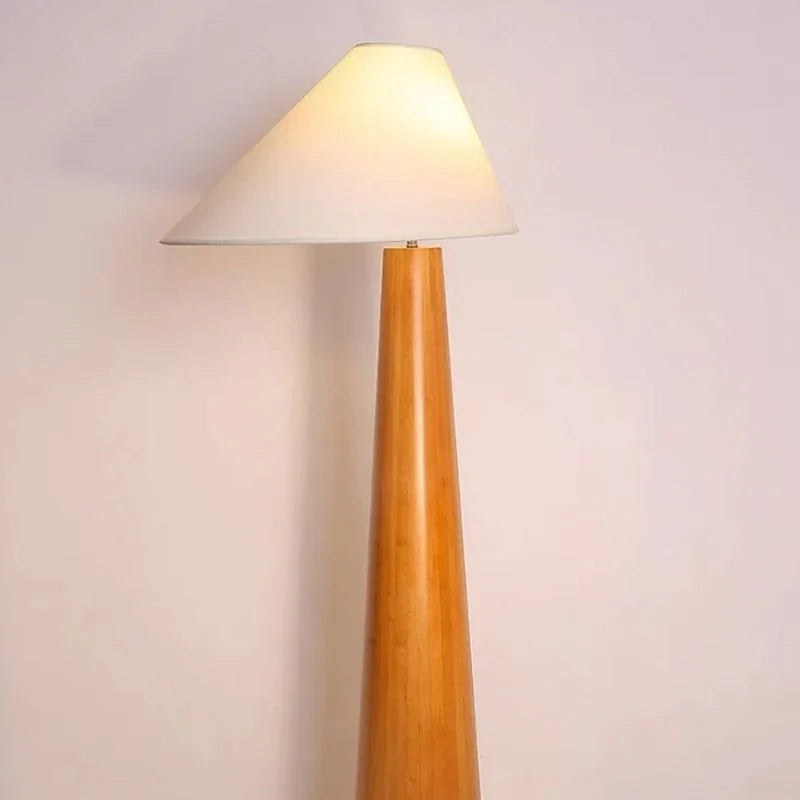
A good Japandi floor lamp does one thing above all: it gives warm, low, diffused light instead of a bright overhead glare. Below you will find the lamp types that work in a Japandi room, where to put them, which bulb to use, and 10 picks from our collection that get the light right, from a cordless glass lamp around $210 to a solid oak statement piece.
The Japandi rooms that feel calm almost never rely on the ceiling light; they rely on two or three small pools of warm light at eye level and below. A floor lamp is the easiest way to add one without drilling or rewiring.
Why lighting is the most-missed part of Japandi
People buy the low sofa, the oak coffee table and the linen cushions, then switch on a 4000K ceiling fixture and wonder why the room still feels like an office. Japandi borrows from Japanese interiors, where light comes through paper screens and lanterns, and from Scandinavian homes, where warm lamplight is a winter ritual. Three rules follow:
- Warm. Light should look like candle or late-afternoon sun, not daylight. In bulb terms, that is 2700K (more on this below).
- Low. The light source sits at or below eye level when you are seated. Floor lamps and table lamps, not downlights.
- Layered. A pendant for general light, a floor lamp beside the sofa, a table lamp on a sideboard. Each one on its own dimmer, so you can take the room from "reading" to "evening" without a hard switch.
The five Japandi floor lamp types
Most lamps in this style fall into one of five shapes.
1. Paper lantern and parchment shades
The most Japanese of the group: a thin paper or parchment shade on a simple frame gives an even, milky glow with no hot spots. Best for pure mood lighting. The trade-off: the shade cannot be washed, can yellow near a sunny window, and is not meant for reading.
2. Tripod and wood-stem lamps
Three slim legs or a turned wooden column topped with a fabric drum: the Scandinavian side of Japandi. Wood stems are visually light, stable, repeat the oak or walnut already in the room, and usually give enough light to read by.
3. Linen and fabric drum shades
A wide fabric shade on any base. Linen diffuses light like paper but is more forgiving: it can be dusted, ages well and throws more light downward, which helps next to a sofa.
4. Arc lamps
A curved stem that reaches over a sofa or chair so the shade hangs where a pendant would be. The answer when you cannot hang anything from the ceiling. Arc lamps need floor space behind the sofa and a heavy base, so plan the spot before buying.
5. Sculptural lamps
Stacked orbs, fluted columns, organic forms: lamps you choose for the shape first. They glow softly and act as art when off. Ambient, not task, light; one per room is plenty.
Where to put a floor lamp
- Beside the sofa. At one end of the sofa, slightly behind the armrest, so the light falls on the seat and side table. If the sofa floats in the room, an arc lamp from behind does the same job.
- Reading corner. A lounge chair, a small table and a lamp whose shade sits just above your shoulder when seated. Choose a fabric or wood-stem lamp that points light down, not a lantern.
- Bedroom. A floor lamp in the corner beside a low platform bed frees the nightstand. Choose the softest lamp you own for this spot: a paper lantern or a frosted globe.
- Dark corner of an open-plan room. A tall, slim or sculptural lamp in the dead corner makes the whole room feel bigger.
Bulbs and color temperature: 2700K and dimmable
The lamp is only half the job. Whatever you buy, fit it with a 2700K LED bulb ("warm white" or "soft white" on the box). 3000K is acceptable in a kitchen; 4000K and above is cool and flat and will undo the look of any lamp here. For brightness, 400 to 800 lumens is enough; use the top of that range for reading.
Buy a dimmable bulb and, if the lamp has no built-in dimmer, add a plug-in dimmer or a smart bulb. Being able to drop a lamp to 20 percent in the evening matters more than any other spec. Some lamps have integrated LEDs, so the bulb is not replaceable; check the product page if that worries you.
Materials and colors that fit
Stick to materials already in the room: oak, walnut, black or brass-toned metal, linen, parchment, frosted glass, and stone or ceramic for the base. Shades should be off-white, oatmeal, sand or soft grey. Avoid glossy chrome, bright colors and visible plastic. One warning from experience: a pure white shade next to warm wood can look pink under a 2700K bulb, so oatmeal or natural linen is the safer choice in a wood-heavy room.
The 10 best Japandi floor lamps in our collection
Our collection has 23 lamps; these are the ones we would put in our own homes, with the honest trade-offs. Most are from Residence Supply, whose lighting is priced at the higher end, so we added a cheaper entry at the end.
Modern Japandi Floor Lamp

Our best-selling floor lamp and the purest Japandi shape here: a thin metal stem with a neutral parchment shade that glows like a paper lantern but holds its shape better. Soft, even light for a sofa side or bedroom corner. Around $790. Not a reading lamp; it is the one you switch on at dusk and leave on. See details
Japandi Solid Oak Floor Lamp With Clean Lines – Holza

A gently tapered oak base with an angled, linen-like shade that tilts light toward the seat beside it. The one for a reading corner in a room that already has oak furniture. The most expensive lamp on the list at around $2,125, so treat it as the statement piece. See details
Japandi Sculptural Wood & Fabric Floor Lamp – Inara

A smooth, column-like wood-finish base on an iron frame, topped with a wide fabric drum. It gives the broadest pool of light of the wood-stem group, and there is a matching table lamp. Around $665, the best value among the Residence Supply lamps. Good beside a sofa or in a media room. See details
Japandi Vertical Glass Rod Floor Lamp – Svetlina

A tall, slim cylinder: a stitched fabric shade wrapped around the light core on a natural wood base. Because it glows along its full height, it suits a dead corner or the side of a low platform bed. Around $1,155. It takes very little floor space, its real strength in a small apartment. See details
Japandi Curved Brass & Fabric Shade Floor Lamp – Modern Twist

An hourglass silhouette with a pleated fabric shade on a brass-toned frame. The pleats break the light into soft bands, so the glow is gentle without being flat. It adds movement to a very minimal room and pairs well with walnut. Around $905. In a strictly black-and-oak room, the brass may be one accent too many. See details
Japandi Minimalist Arched Metal Floor Lamp – Bitqu

Our arc pick. A subtly curved metal stem rises from a textured, stone-like ceramic base and holds a tapered fabric shade over the seat below. The heavy base is the point: it lets the curve reach over a sofa or lounge chair. Around $1,915. You need clear floor behind the seating, so measure first. See details
Japandi Dual Shade Sculptural Floor Lamp – Galix

A frosted globe on a slim brass-finished stem with a marble-look base. The globe throws light in every direction, so it suits a corner seen from several angles. Frosted glass gives the softest light here after paper. Around $1,505. Being glass, it is the one we would not put in a playroom. See details
Japandi Textured Beaded Wood Floor Lamp – Beaded

A vertical column of glowing orbs stacked like river pebbles, built from marble, glass and aluminum. Each orb is a diffuser, so the light is even from floor to top and the lamp reads like a lantern tower when lit. Around $1,095. Pure ambient light and a strong shape, so give it its own corner. See details
Japandi Double Floor Lamp

Two lights on one wooden frame: a fabric shade at the top for reading, and a lower cylinder for ambient light at knee height. Switch the top off in the evening and you have a night lamp. Around $975. It solves "I need task light but want it soft" in one piece, so it earns the spot beside the lounge chair. See details
Japandi Glass Floor Lamp

The budget pick, around $210: a frosted glass shade on a stainless steel stem. It is cordless, so it is the easiest lamp here to move around, and the frosted shade gives genuinely soft light. The trade-offs are what you would expect at this price: lighter build, less presence in a large room, and check the battery details on the product page before making it your main evening light. See details
More Japandi floor lamps worth a look
 Japandi Minimalist Matte Black Floor Lamp – Himins
 Japandi Natural Wood Floor Lamp With Slatted Design – Izbu
 Traditional Japandi Floor Lamp
Layering: pairing a floor lamp with pendants and table lamps
One floor lamp improves a room, but the Japandi feel comes from three light sources at three heights: a pendant over the coffee or dining table on a dimmer (a paper or rattan shade keeps it soft), a floor lamp beside the sofa, and a table lamp on a sideboard across the room. Keep every bulb at the same color temperature; mixing 2700K and 4000K in one room is the most common mistake we see.
FAQ
What color temperature is right for a Japandi room?
2700K. It is the warm end of standard LED bulbs and the closest match to the paper-lantern and candle light the style is built on. 3000K is an acceptable compromise in a kitchen or a home office, but for a living room or bedroom floor lamp, stay at 2700K and buy dimmable.
Is a paper lantern floor lamp safe?
Yes, with an LED bulb. LEDs run cool, so a paper or parchment shade is not the fire risk it was with incandescent bulbs. Stay within the wattage printed on the lamp, keep the shade away from radiators and direct sun, and clean it with a soft brush, never water.
How tall should a Japandi floor lamp be?
Beside a sofa or reading chair, the bottom of the shade should sit at about shoulder height when you are seated, roughly 110 to 150 cm (43 to 59 in) from the floor; that keeps the bulb out of your eyes. A lamp placed in a corner purely for ambience can be taller, 150 to 180 cm (59 to 71 in), since you are not looking under the shade.
Complete your Japandi living room
- Japandi pendant lights for the overhead layer
- Japandi table lamps for sideboards and nightstands
- Japandi sofas to put the lamp beside
- Japandi ceiling lights for rooms without a hanging point
If you only change one thing in your room this month, make it the light: a warm, dimmable Japandi floor lamp beside the sofa will do more for the mood than any cushion or vase.
Keep reading
- Japandi Pendant Lights for the Dining Table and Kitchen: 10 Picks
- Japandi Small Apartment Ideas: Calm, Light and Clutter-Free
Japandistore selects products from partner stores and may earn a commission when you buy through our links. Prices are set by the stores and can change.

Leave a comment
This site is protected by hCaptcha and the hCaptcha Privacy Policy and Terms of Service apply.